Quick answer
- Adult acne can carry on from the teenage years or start for the first time after age 25, and DermNet says it affects up to 15 percent of women.
- Acne that persists on the lower face, jawline and neck despite several treatments is one of the signs that it may respond to hormonal therapy.
- Spironolactone made objectively assessed improvement about six times more likely than placebo in a 2025 meta-analysis of five trials with 563 women.
In this post
Acne is often thought of as a teenage problem, but many women deal with it well into their 30s and 40s, and some get it for the first time as adults. Adult acne in women frequently follows a recognizable pattern, and dermatologists have specific tools for it. This article explains what is known and why a medical assessment is the right starting point.
What counts as adult acne
DermNet describes adult acne, also called postadolescent acne, in two forms:
- Persistent acne, which starts in the teenage years and carries on into adulthood.
- Late-onset acne, which first appears after age 25.
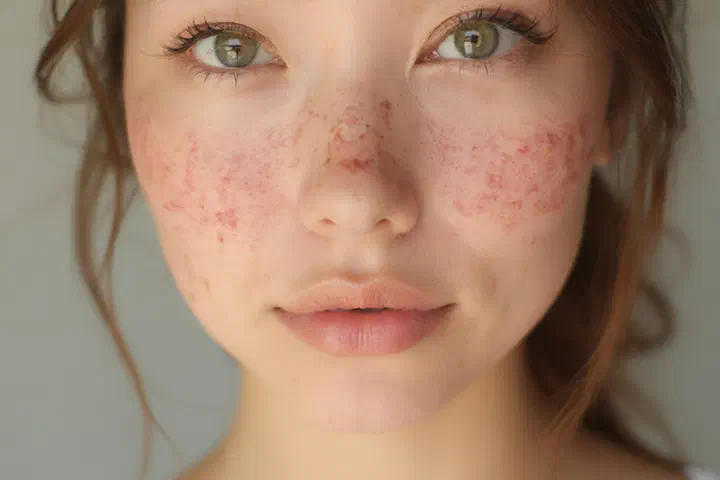
According to DermNet, adult acne affects up to 15 percent of women and is usually reported as less common in men. It tends to be mild to moderate, but deep inflammatory spots and large whiteheads can still leave scars.

The hormonal pattern
The American Academy of Dermatology (AAD) lists several signs that suggest acne may respond to hormonal therapy:
- Acne that persists on the lower face, jawline and neck despite several treatments
- Poor results from a course of antibiotics
- Breakouts on the chest or back that are hard to clear
DermNet adds that premenstrual flares are common in adult women, that large closed comedones (whiteheads) often appear on the chin, cheeks and forehead, and that many women notice enlarged pores.
Why it happens
Hormones are one of several triggers. The AAD names several triggers for adult acne:
| Trigger | What the sources say |
|---|---|
| Hormone shifts | Breakouts around periods, during pregnancy, perimenopause and menopause, and after starting or stopping birth control pills |
| Stress | Stress prompts the body to make more androgens, which stimulate oil glands |
| Family history | People with a close relative who has acne may be more likely to develop adult acne |
| Skin and hair products | Products that are not labeled non-comedogenic or oil-free can contribute |
| Medicines | Some medicines list acne as a side effect |
| Underlying conditions | Acne can be a sign of another health problem and often clears once that is treated |
DermNet also notes links with smoking and oily face creams for comedonal acne, and recommends non-occlusive makeup.
When acne points to an ovarian condition
One condition worth knowing about is the one long known as polycystic ovary syndrome (PCOS). The Cleveland Clinic now refers to it as PMOS, polyendocrine metabolic ovarian syndrome, formerly known as PCOS, and the NHS lists it among conditions linked to acne. In this condition the ovaries produce higher than usual levels of androgens. The Cleveland Clinic says it is typically diagnosed when at least two of these are present: irregular or missed periods, signs of excess androgens such as acne or extra hair growth, and ovaries that look polycystic on ultrasound. If acne comes with irregular periods or new hair growth on the face or body, mention this to your doctor.
Treatments dermatologists use
DermNet notes that adult acne is generally treated in the same way as acne in younger people, though because it tends to persist, stronger options may be considered earlier. Dermatologists often combine two or more treatments, according to the AAD. What follows describes the main categories, and the choice between them belongs in a conversation with a doctor.
Topical treatments
For milder acne, creams and gels come first. The NHS lists topical retinoids such as tretinoin and adapalene, which reduce inflammation and oiliness, and topical antibiotics such as clindamycin. Pharmacy products such as benzoyl peroxide and salicylic acid are also options. DermNet points out that topical treatments suppress acne rather than cure it, so they need to be continued.
Combined oral contraceptives
Combined pills contain an estrogen and a progestin. The AAD notes that the FDA has approved some of them for acne and that improvement typically appears in two to three months. DermNet reports roughly 40 to 50 percent improvement by the third cycle and 80 to 90 percent by the ninth.
The type of progestin matters. DermNet lists pills containing cyproterone acetate, drospirenone or dienogest as having anti-androgen effects, while pills with levonorgestrel or norgestrel are androgenic and generally unsuitable for acne. Progestogen-only pills are not effective for androgen-driven skin conditions.
The pill is not suitable for everyone. The AAD lists risks including blood clots, heart attack and high blood pressure, and notes that women aged 35 or older and those with a history of clots or stroke may need to avoid it. DermNet adds smoking, uncontrolled high blood pressure and a family history of early clots to the list of reasons for caution. A prescriber will check blood pressure and medical history first.
Spironolactone
Spironolactone was developed as a diuretic for high blood pressure and fluid retention. Dermatologists use it because it blocks some effects of androgens on oil glands. The AAD says it is used particularly for deep, tender acne on the lower face, jawline or neck, sometimes alone and sometimes with the pill. DermNet notes anti-androgens are not suitable for skin problems in men.
Evidence. A 2025 meta-analysis in the Journal of Cosmetic Dermatology pooled five randomized placebo-controlled trials with 563 women. Objectively assessed improvement was about six times more likely with spironolactone than placebo, and the pooled data did not show a significant increase in menstrual irregularities or breast enlargement. The AAD cites a study of 85 women in which about a third had complete clearing and about a third had noticeably less acne.
Timing. The AAD says reduced oiliness and breakouts may appear within a few weeks, while DermNet notes full improvement can take six months or longer.
Side effects and precautions. According to the AAD, common side effects when taken without the pill include irregular or painful periods and breast tenderness, and frequent urination is expected. Key precautions from the AAD and DermNet:
- Pregnancy. Spironolactone can cause serious birth defects. Effective contraception is essential, and it should not be taken while breastfeeding.
- Potassium. Blood tests are done before starting. The AAD advises avoiding potassium supplements and coconut water.
- Gradual dosing. The dose is usually increased slowly, so early follow-up visits are common.
Isotretinoin
For severe or stubborn acne, DermNet describes oral isotretinoin as very effective, able to suppress acne for years, but with significant side effects and risks. It must not be taken during pregnancy.
What to expect over time
Hormonal treatments work slowly and are often long-term. The AAD notes they can be used safely over long periods and that, once acne clears, some people can stop antibiotics and topicals. DermNet cautions that skin often worsens within a few months of stopping hormonal treatment.

When to see a doctor
The NHS recommends seeing a GP if self-care has not helped, if spots are deep, painful or scarring, if there are signs of infection, or if acne is affecting your mental health. Hormonal treatments need a prescription, a review of your health history and, in some cases, blood tests, so they are always a decision to make with a doctor. With professional help and some patience, the AAD says nearly every case of acne can be controlled.
Sources
- Adult acneAmerican Academy of Dermatology
- Stubborn acne? Hormonal therapy may helpAmerican Academy of Dermatology
- Adult acneDermNet
- Anti-androgen therapyDermNet
- AcneNHS
- PMOS (Polyendocrine Metabolic Ovarian Syndrome)Cleveland Clinic
- Efficacy and Safety of Oral Spironolactone for Women With Acne Vulgaris: A Systematic Review and Meta-Analysis of Randomized Placebo-Controlled Trials With Trial Sequential AnalysisJournal of Cosmetic Dermatology (Europe PMC)
Filed under adult acne, treatments