Quick answer
- No single treatment is best for all acne scars, and combining treatments often improves results.
- Subcision suits rolling scars, TCA CROSS suits ice pick scars, and microneedling works best on rolling scars, then boxcar scars.
- Ablative fractional lasers appear the most effective energy-based option, at the cost of more pain, downtime and risk of pigment changes.
In this post
There is no single best treatment for acne scars. A 2022 review in Clinical, Cosmetic and Investigational Dermatology says so directly, and the American Academy of Dermatology (AAD) notes that combining treatments often improves results. What the research does show is that each procedure fits some scar types much better than others. This guide compares the most widely used options.
Before comparing: two ground rules
Active acne comes first. DermNet, the AAD and the Cleveland Clinic all say scar treatment should start once acne is under control. New breakouts mean new inflammation and new scars.
Medication history matters. The AAD advises telling your dermatologist about every acne treatment used in the past two years, because some scar treatments can cause side effects if started during or soon after certain acne medications. The 2022 review mentions reports of keloids after dermabrasion in people who had recently taken isotretinoin.
Quick comparison
| Treatment | Best matched to | Sessions in published studies | Recovery notes |
|---|---|---|---|
| Subcision | Rolling scars | Often combined with other methods; effect can fade as bands reform | Bruising, swelling, redness |
| Ablative fractional laser | Mixed atrophic scars | 1 to 6 sessions, about 4 weeks to 2 months apart | Most downtime of the energy devices; redness, swelling, crusting |
| Non-ablative fractional laser | Mixed atrophic scars | Varies by laser type | Gentler, with smaller gains than ablative |
| Microneedling | Rolling, then boxcar | 2 to 5 sessions, 2 to 8 weeks apart | Redness and swelling that settle on their own |
| TCA CROSS | Ice pick scars | Repeated sessions; one study used 4 sessions 2 weeks apart | Treated spots peel over several days |
| Fillers | Rolling scars | Repeat treatments as the filler breaks down | Pain, swelling, tenderness |
Subcision
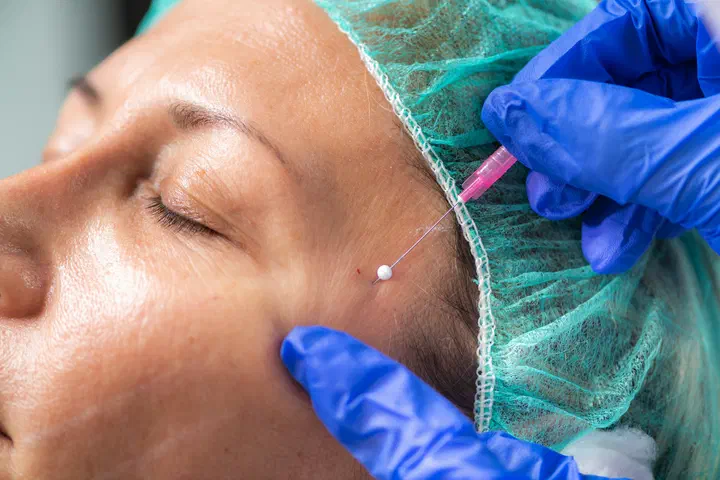
Subcision uses a needle inserted under the skin and moved in a fanning motion to cut the fibrous strands that tether a rolling scar, usually under local anesthetic. The Cleveland Clinic describes it as breaking the bands so the skin can rise.
What the evidence says. A 2017 systematic review in Scars, Burns & Healing looked at ten subcision studies, mostly on rolling scars, and found reported improvement ranging widely from 10 to 100 percent. The 2022 review calls it the best option for rolling scars and largely ineffective for boxcar and ice pick scars. It also notes the benefit can fade as the bands reform, which is why subcision is often paired with microneedling, suction, acid application or fillers.
Recovery and risks. Reported side effects include swelling, bruising, redness, pain and darkening of the skin, with hypertrophic scarring and infection described as rare. Blunt instruments are considered safer than sharp needles.
Fractional lasers: ablative and non-ablative
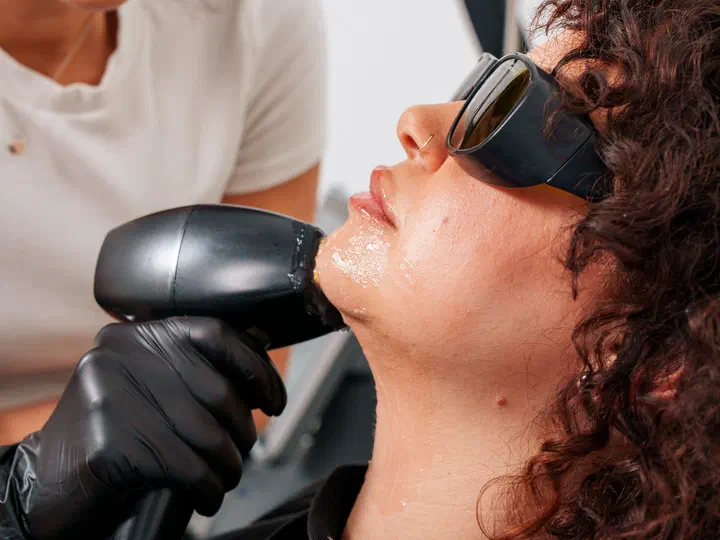
Laser resurfacing heats scarred collagen to prompt new collagen growth, and the Cleveland Clinic notes both ablative and non-ablative types are used.
What the evidence says. Part 2 of the Scars, Burns & Healing review covered energy-based devices across 59 articles. Its authors concluded that ablative lasers appear to be the most effective, at the cost of significant pain, downtime and a risk of long-term pigment changes. Non-ablative fractional lasers have a much safer profile but cannot match those results. Fractional radiofrequency microneedling was slightly less effective than non-ablative lasers, with an even gentler safety profile. The authors also stressed the lack of high-quality evidence and the absence of a standard scar scoring scale.
A 2025 systematic review in Life focused on fractional CO2 lasers, which are ablative. Across seven studies, most patients showed roughly 30 to 70 percent improvement. Protocols ranged from a single session to six, spaced about four weeks to two months apart.
Recovery and risks. In that review, redness and swelling typically lasted 24 to 48 hours, though the authors note it could last up to several weeks. Crusting, flaking, pinpoint bleeding and temporary darkening were reported. One study reported darkening lasting four to seven weeks, another recorded cold sore outbreaks, and another recorded acne flares. Most follow-up lasted six months or less.
Microneedling
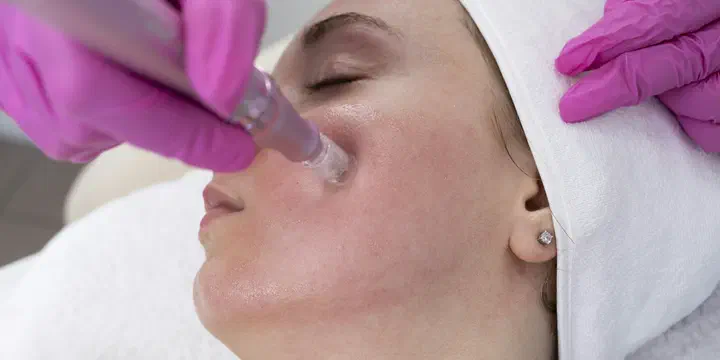
Microneedling uses fine needles to create tiny controlled injuries that trigger collagen production. The AAD describes it as safe for all skin tones and notes it is often combined with radiofrequency, chemical peels or platelet-rich plasma.
What the evidence says. The 2022 review rates microneedling as most effective for rolling scars, then boxcar scars, with little effect on ice pick scars. Studies in the 2017 review used two to five sessions. Adding a glycolic acid peel or platelet-rich plasma improved results in some studies, though the 2022 review describes the platelet-rich plasma evidence as mixed.
Recovery and risks. Redness, swelling and pain are common and resolve on their own. Skin darkening is uncommon. The 2022 review notes reports of “tram-track” scarring over bony areas such as the temples and forehead.
TCA CROSS
TCA CROSS (chemical reconstruction of skin scars) applies highly concentrated trichloroacetic acid directly into the base of each scar with a fine applicator. Unlike a full-face peel, it targets individual pits.
What the evidence says. This is the option most associated with ice pick scars. The 2017 review found it was the most effective chemical peel technique in its set. In one study of ice pick scars, four sessions of 100 percent TCA two weeks apart produced excellent improvement in 73.3 percent of patients. The 2022 review says repeated sessions give the most consistent results and reports that 50 percent concentrations have worked with fewer complications.
Recovery and risks. Treated skin sheds over several days. Darkening of the skin is the most common side effect, and the risk is higher in darker skin types, at concentrations above 50 percent and with poor aftercare. Applying acid to surrounding skin can worsen the scar, so precision matters.
Fillers
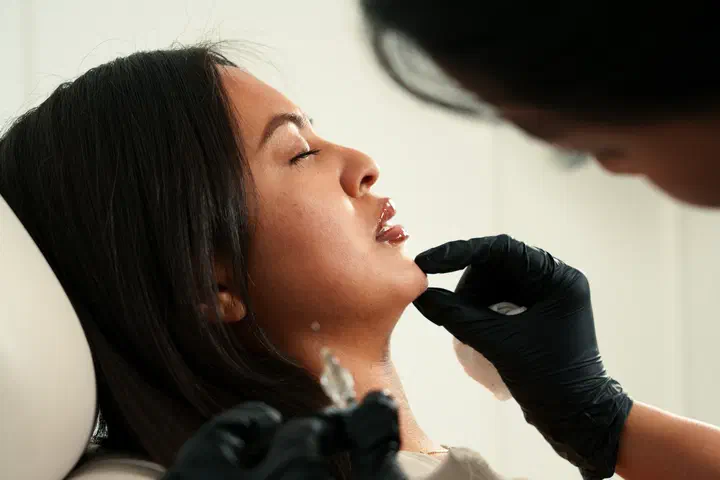
Fillers lift depressed scars by adding volume, and some may also stimulate collagen. They mainly suit rolling scars.
What the evidence says. The 2022 review lists hyaluronic acid fillers as lasting about 6 to 18 months, poly-L-lactic acid about 24 months, and polymethyl methacrylate as permanent. In a double-blind trial included in the 2017 review, 84 percent of patients treated with polymethyl methacrylate improved at six months compared with 54 percent of controls. The AAD notes that most filler plans need a series of visits and touch-ups, even with permanent products, as skin ages.
Recovery and risks. Pain, tenderness and swelling are common. Nodules and skin darkening were reported with poly-L-lactic acid in some patients.
Other options worth knowing
- Punch techniques cut out or lift individual deep scars. The 2022 review describes punch excision for ice pick scars and punch elevation for boxcar scars.
- Raised scars need different care. DermNet lists steroid injections, silicone gel or sheeting, pulsed dye laser and cryotherapy for hypertrophic scars and keloids, which are prone to recurrence.
Setting expectations
The Cleveland Clinic states plainly that scars may not disappear and there is no guarantee of complete removal, though most treatments reduce size and visibility. Because study designs, scar grading and follow-up vary so much, a dermatologist’s plan for your specific scar mix is more useful than any single success rate.
Sources
- Acne scars: Consultation and treatmentAmerican Academy of Dermatology
- Acne scarringDermNet
- Acne Scars: Causes, Diagnosis, Types and TreatmentCleveland Clinic
- A systematic review of treatments for acne scarring. Part 1: Non-energy-based techniquesScars, Burns & Healing (PMC)
- A systematic review of treatments for acne scarring. Part 2: Energy-based techniquesScars, Burns & Healing (Europe PMC)
- A Comprehensive Review of Non-Energy-Based Treatments for Atrophic Acne ScarringClinical, Cosmetic and Investigational Dermatology (PMC)
- The Use of a Fractional Laser in Acne Scar Treatment: A Systematic ReviewLife (PMC)
Filed under acne scars, treatments